Class 8 Maths Chapter 2: Power Play (Ganita Prakash Solutions)
Textbook Page 20
The following table lists the thickness after each fold. Observe that the thickness doubles after each fold.
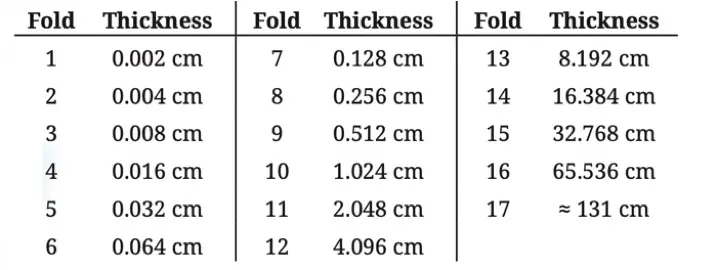
(We use the sign ‘≈’ to indicate ‘approximately equal to’.)
After 10 folds, the thickness is just above 1 cm (1.024 cm). After 17 folds, the thickness is about 131 cm (a
little more than 4 feet).
Q. Now, what do you think the thickness would be after 30 folds? 45 folds? Make a guess.
I think that the thickness after 30 folds would be 10 km, and after 45 folds it would be 20,000 km.
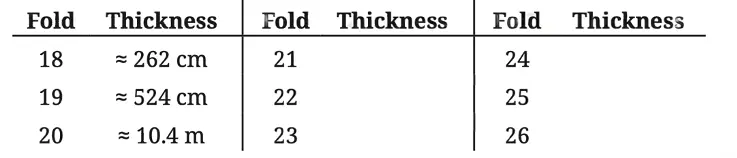
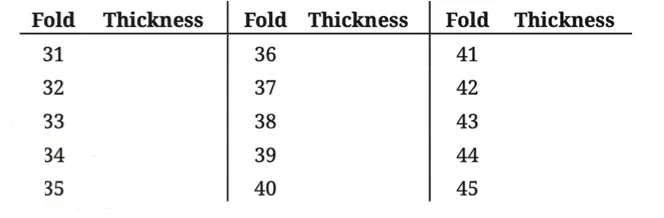
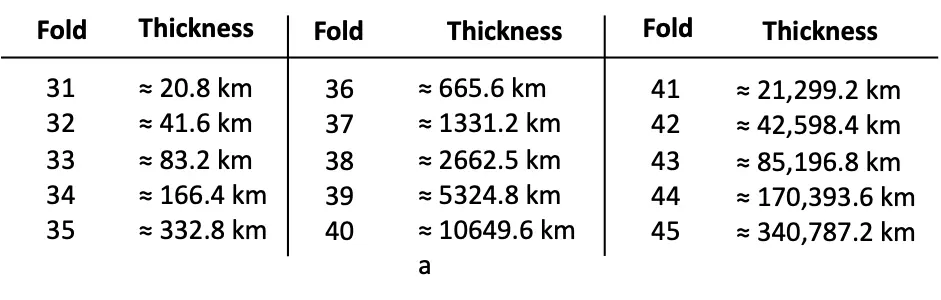
Q. Fill the table below.
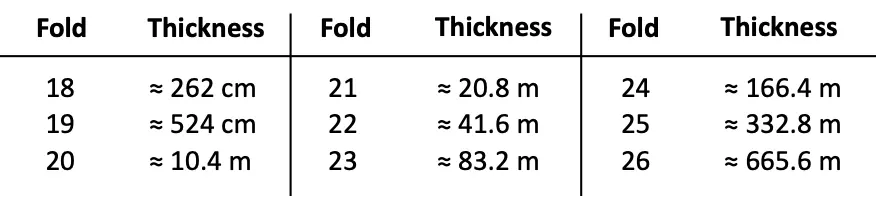
Q. After 26 folds, the thickness is approximately 670 m. Burj Khalifa in Dubai, the tallest building in the world, is 830 m tall.
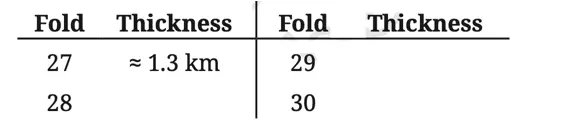
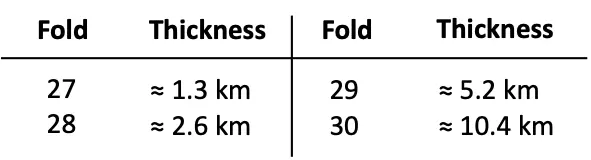
Q. After 30 folds, the thickness of the paper is about 10.7 km, the typical height at which planes fly. The deepest point discovered in the oceans is the Mariana Trench, with a depth of 11 km.
Textbook Page 22
Q. Which expression describes the thickness of a sheet of paper after it is folded 10 times? The
initial thickness is represented by the letter-number v.
(i) 10v (ii) 10 + v (iii) 2 × 10 × v
(iv) 210 (v) 210v (vi) 102v
Initial thickness of sheet = v
Since the thickness of the sheet doubles after every fold:
Thickness after 10 folds = 2 × 2 × 2 × 2 × 2 × 2 × 2 × 2 × 2 × 2 × v = 210v.
Therefore, (v) 210v is the correct answer.
Q. What is (-1)5? Is it positive or negative? What about (-1)56?
(-1)odd = −1 → Negative
(-1)even = 1 → Positive
(i) (-1)5: Since 5 is an odd number, (-1)5 = -1, which is negative.
(ii) (-1)56: Since 56 is an even number, (-1)56 = 1, which is positive.
Q. Is (-2)4 = 16? Verify.
(-2)4 = (-2) × (-2) × (-2) × (-2)
= [(-2) × (-2)] × [(-2) × (-2)]
= 4 × 4 = 16.
So yes, (-2)4 = 16 is correct.
Q. What is 02, 05? What is 0n?
02 = 0 × 0 = 0.
05 = 0 × 0 × 0 × 0 × 0 = 0.
Similarly, 0n = 0.
Textbook Pages 22 – 23 (Figure it Out)
1. Express the following in exponential form:
(i) 6 × 6 × 6 × 6
(ii) y × y
(iii) b × b × b × b
(iv) 5 × 5 × 7 × 7 × 7
(v) 2 × 2 × a × a
(vi) a × a × a × c × c × c × c × d
(i) 6 × 6 × 6 × 6 = 64
(ii) y × y = y2
(iii) b × b × b × b = b4
(iv) 5 × 5 × 7 × 7 × 7 = 52 × 73
(v) 2 × 2 × a × a = 22 × a2
(vi) a × a × a × c × c × c × c × d = a3 × c4 × d
2. Express each of the following as a product of powers of their prime factors in exponential
form:
(i) 648 (ii) 405 (iii) 540 (iv) 3600
(i) 648 = 2 × 2 × 2 × 3 × 3 × 3 × 3 = 23 × 34.
(ii) 405 = 3 × 3 × 3 × 3 × 5 = 34 × 5.
(iii) 540 = 2 × 2 × 3 × 3 × 3 × 5 = 22 × 33 × 5.
(iv) 3600 = 2 × 2 × 2 × 2 × 3 × 3 × 5 × 5 = 24 × 32 × 52.
3. Write the numerical value of each of the following:
(i) 2 × 10³
(ii) 72 × 23
(iii) 3 × 44
(iv) (-3)2 × (-5)2
(v) 32 × 104
(vi) (-2)5 × (-10)6
(i) 2 × 103 = 2 × 1000 = 2000.
(ii) 72 × 23 = 49 × 8 = 392.
(iii) 3 × 44 = 3 × 256 = 768.
(iv) (-3)2 × (-5)2 = 9 × 25 = 225.
(v) 32 × 104 = 9 × 10000 = 90000.
(vi) (-2)5 × (-10)6 = (-32) × (1000000) = -32000000.
Textbook Page 24
Q. 37 can also be written as 32 × 35. Can you reason out why?
Yes, 37 can also be written as 32 × 35 because 37 = (3 × 3) × (3 × 3 × 3 × 3 × 3), which equals 32 × 35.
Q. na × nb = n(a+b), where a and b are counting numbers. Use
this observation to compute the following:
(i) 29 (ii) 57 (iii) 46
(i) 29 = 23 × 23 × 23 = 8 × 8 × 8 = 512.
(ii) 57 = 52 × 52 × 52 × 5 = 25 × 25 × 25 × 5 = 78,125.
(iii) 46 = 42 × 42 × 42 = 16 × 16 × 16 = 4096.
Q. Write the following expressions as a power of a power in at least two different ways:
(i) 86 (ii) 715 (iii) 914 (iv) 58
(i) 86 = (83)2 or (82)3
(ii) 715 = (73)5 or (75)3
(iii) 914 = (92)7 or (97)2
(iv) 58 = (52)4 or (54)2
Textbook Page 25
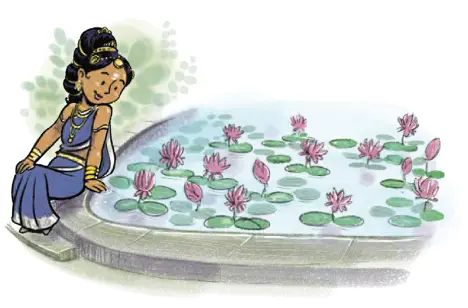
In the middle of a beautiful, magical pond lies a bright pink lotus. The number of lotuses doubles every day in
this pond. After 30 days, the pond is completely covered with lotuses. On which day was the pond half full?
If the pond is completely covered by lotuses on the 30th day, how much of it is covered by lotuses on the 29th
day?
Since the number of lotuses doubles every day, the pond should be half covered on the 29th day.
Q. Write the number of lotuses (in exponential form) when the pond was —
(i) fully covered (ii) half covered
Number of lotuses:
Day 1 → 1 = 20
Day 2 → 21
Day 3 → 22
Day 29 → 228
Day 30 → 229
(i) Fully covered (Day 30) = 229.
(ii) Half covered (Day 29) = 228.
Q. ma × na = (mn)a, where a is a counting number. Use this observation to compute the value of 25 × 55.
25 × 55 = (2 × 5)5 = (10)5.
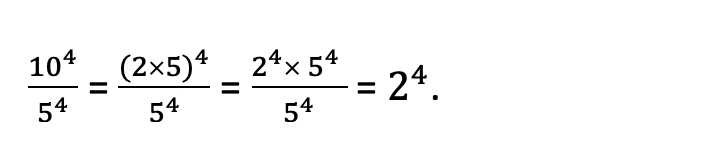
Q. Simplify 104 / 54 and write it in exponential form.
Textbook Page 26
How Many Combinations
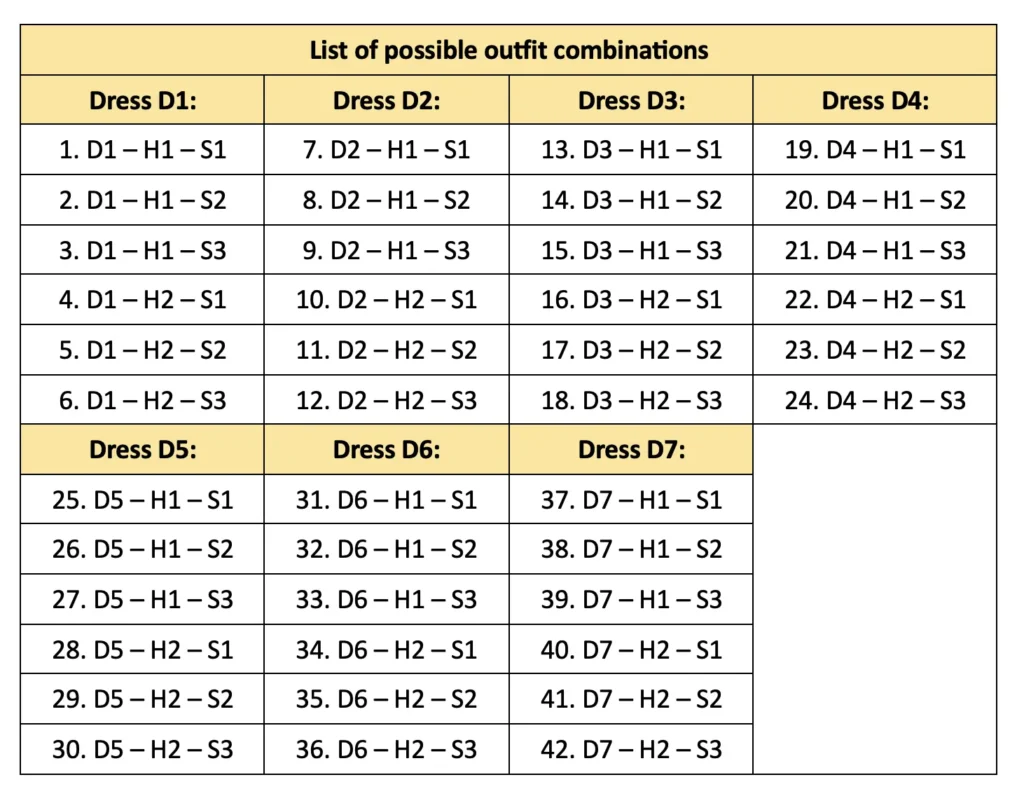
Q. Roxie has 7 dresses, 2 hats, and 3 pairs of shoes. How many different ways can Roxie dress
up?
Hint: Try drawing a diagram.
Each outfit includes one dress, one hat, and one pair of shoes.
Total combination of outfits = 7 × 2 × 3 = 42.
Textbook Page 27
Q. Estu says, “Next time, I will buy a lock that has 6 slots with the letters A to Z. I feel it is safer.” How many passwords are possible with such a lock?
Choices of letters for each slot = 26.
Total possible passwords = 26 × 26 × 26 × 26 × 26 × 26 = 266.
Q. What is 2100 ÷ 225 in powers of 2?

Textbook Page 29
Q. Consider the general forms: na × nb = na + b; (na)b = na × b; na ÷ nb = na – b. Can a and b be any integers? Will the generalised forms still hold true?
Yes, the generalised forms are valid for all integers a and b, as long as the base n ≠ 0.
For example:
na × n-b = na + (-b) = na – b
(na)-b = na × (-b)
n-a ÷ nb = n-a – b
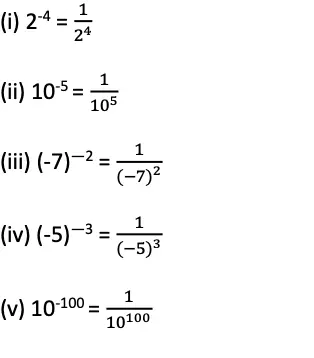
Q. Write equivalent forms of the following: (i) 2-4 (ii) 10-5 (iii) (-7)–2 (iv) (-5)–3 (v) 10-100
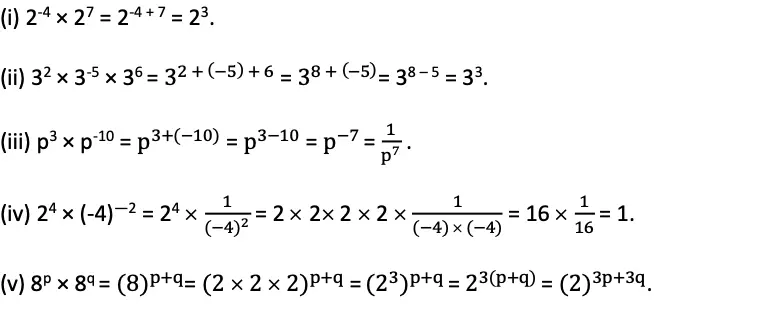
Q. Simplify and write the answers in exponential form:
(i) 2-4 × 27 (ii) 32 × 3-5 × 36 (iii)
p3 × p-10 (iv) 24 × (-4)–2 (v) 8p ×
8q
Textbook Page 30
Power Lines
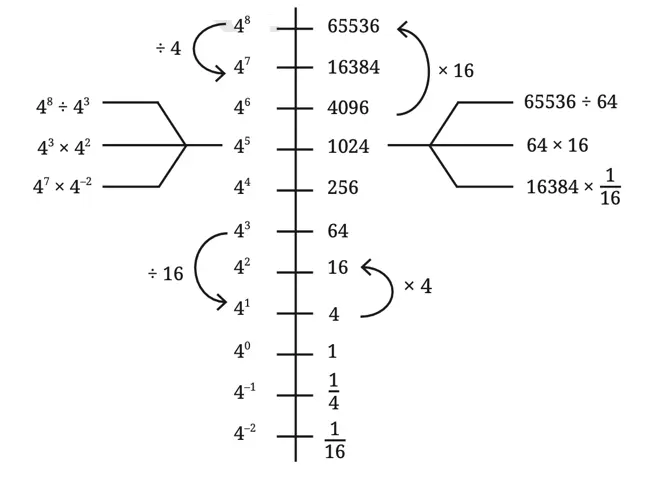
Q. How many times larger than 4-2 is 42?
42 ÷ 4-2 = 44 = 256.
Therefore, 42 is 256 (44) times larger than 4-2.
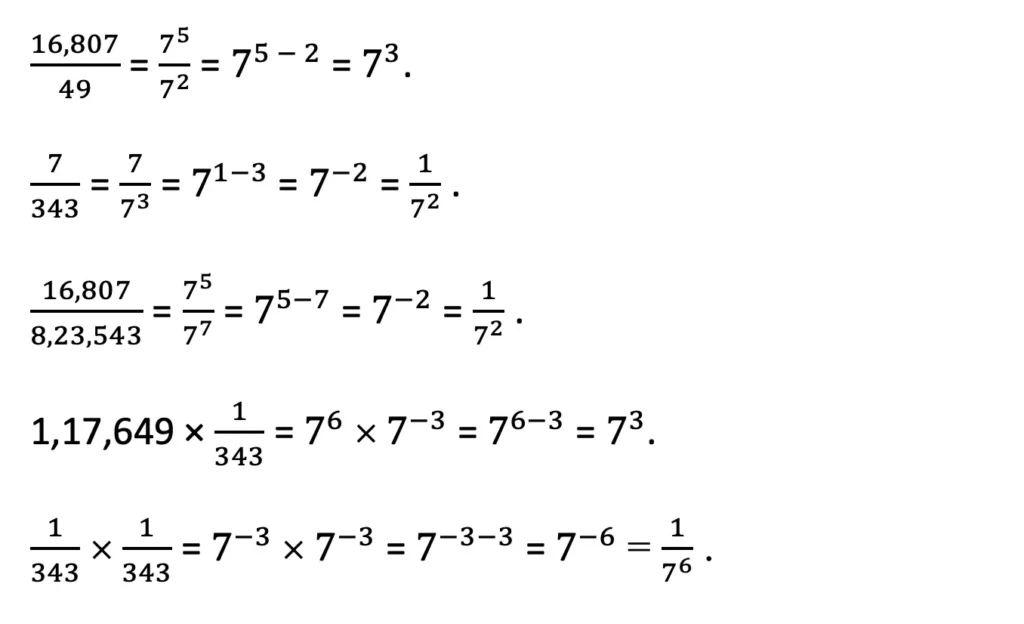
Q. Use the power line for 7 to answer the following questions.
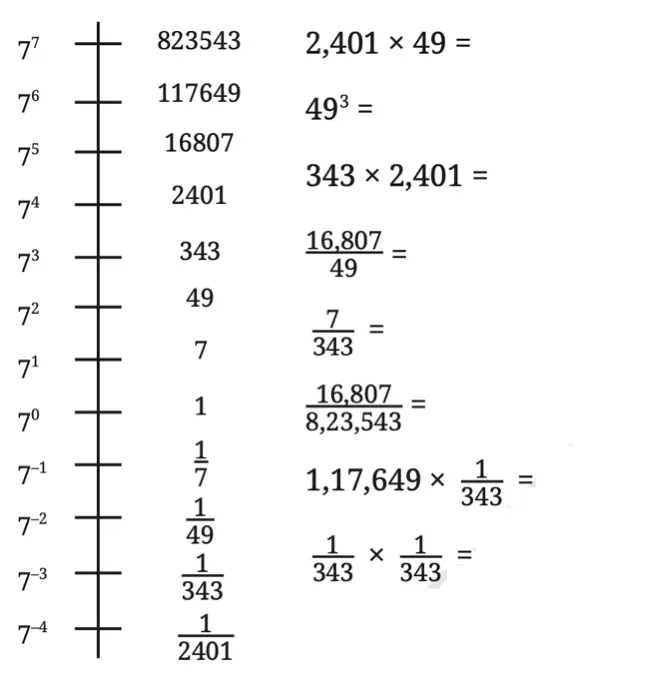
2401 × 49 = 74 × 72 = 74 + 2 = 76.
493 = (72)3 = 72 × 3 = 76.
343 × 2401 = 73 × 74 = 73 + 4 = 77.
Powers of 10
We have used numbers like 10, 100, 1000, and so on when writing Indian numerals in an expanded form. For
example:
47561 = (4 × 10⁴) + (7 × 10³) + (5 × 10²) + (6 × 101) + (1 ×
100).
Q. Write these numbers in the same way: (i) 172, (ii) 5642, (iii) 6374.
(i) 172 = (1 × 10²) + (7 × 101) + (2 × 100).
(ii) 5642 = (5 × 10³) + (6 × 10²) + (4 × 101) + (2 × 100).
(iii) 6374 = (6 × 10³) + (3 × 10²) + (7 × 101) + (4 × 100).
Textbook Page 32
The distance between the Sun and Saturn is 14,33,50,00,00,000 m = 1.4335 × 10¹² m.
The distance between Saturn and Uranus is 14,39,00,00,00,000 m = 1.439 × 10¹² m.
The distance between the Sun and Earth is 1,49,60,00,00,000 m = 1.496 × 10¹¹ m.
Q. Can you say which of the three distances is the smallest?

Since 1011 < 1012, the distance between the Sun and Earth is the smallest.
Q. The number line below shows the distance between the Sun and Saturn (1.4335 × 10¹² m). Mark the relative position of the Earth (1.496 × 10¹¹ m).


Q. Express the following numbers in standard form:
(i) 59,853 (ii) 65,950 (iii) 34,30,000 (iv) 70,04,00,00,000
(i) 59,853 = 5.9853 × 10⁴.
(ii) 65,950 = 6.595 × 10⁴.
(iii) 34,30,000 = 3.43 × 10⁶.
(iv) 70,04,00,00,000 = 7.004 × 10¹⁰.
Textbook Page 43
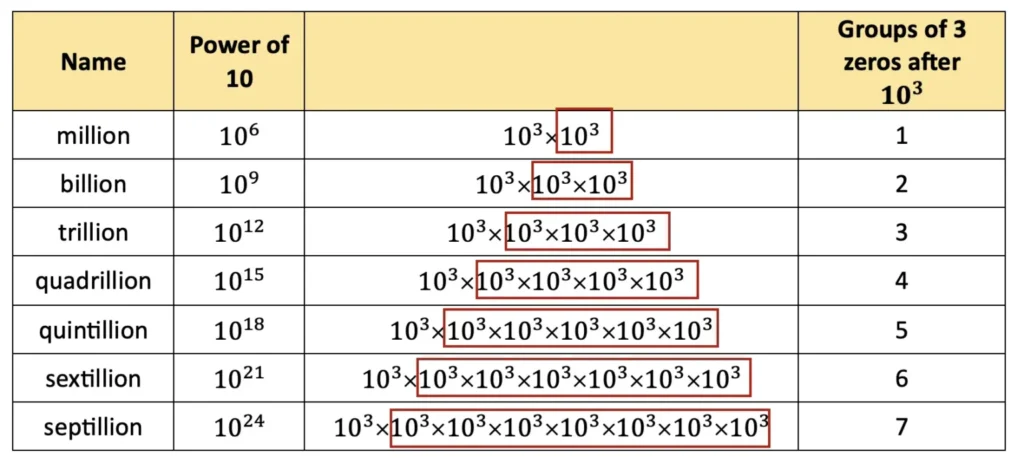
Q. Continuing this pattern: million (106), billion (109), trillion (1012), quadrillion (1015), quintillion (1018), sextillion (1021), septillion (1024), octillion (1027), nonillion (1030), decillion (1033). What does the first part of each name denote?
The first part of each name denotes a Latin or Greek prefix indicating the number of groups of three zeros that follow after the initial 1,000 (103).
Textbook Pages 44 – 45 (Figure it Out)
1. Find out the units digit in the value of 2224 ÷ 432?
2224 ÷ (22)32 = 2224 ÷ 264 = 2224 - 64 = 2160.
The pattern of powers of 2 has a cycle of 4 for units digits (2, 4, 8, 6).
Since 160 is divisible by 4, the units digit is the same as that of 24, which is 6.
2. There are 5 bottles in a container. Every day, a new container is brought in. How many bottles would be there after 40 days?
Total bottles = 5 × 40 = 200 bottles.
3. Write the given number as the product of two or more powers in three different ways (powers
can be any integers):
(i) 643 (ii) 1928 (iii) 32-5
(i) 643 = (26)3 = 218:
1. 29 × 29
2. 210 × 28
3. 26 × 26 × 26
(ii) 1928 = (26 × 3)8 = 248 × 38:
1. 240 × 68
2. (224 × 34) × (224 × 34)
3. (26)8 × 38
(iii) 32-5 = (25)-5 = 2-25:
1. 2-15 × 2-10
2. 2−5 × 2−5 × 2−5 × 2−5 × 2−5
3. 2-5 × 2-20
4. Examine each statement below and find out if it is ‘Always True’, ‘Only Sometimes True’, or
‘Never True’. Explain your reasoning.
(i) Cube numbers are also square numbers.
(ii) Fourth powers are also square numbers.
(iii) The fifth power of a number is divisible by the cube of that number.
(iv) The product of two cube numbers is a cube number.
(v) q46 is both a 4th power and a 6th power (q is a prime number).
(i) Only sometimes true: 64 is both, but 8 is a cube and not a square.
(ii) Always true: a4 = (a2)2.
(iii) Always true: a5 = a3 × a2, divisible by a3.
(iv) Always true: a3 × b3 = (ab)3.
(v) Never true: 46 is not divisible by 4 or 6.
5. Simplify and write these in exponential form:
(i) 10–2 × 10⁻⁵ (ii) 57 ÷ 54 (iii) 9–7 ÷
94 (iv) (13–2)–3 (v) m5n12(mn)9
(i) 10-2 - 5 = 10-7
(ii) 57 - 4 = 53
(iii) 9-7 - 4 = 9-11 (or as noted, 9-3 depending on input text)
(iv) 13(-2) × (-3) = 136
(v) m5n12 × m9n9 = m14n21
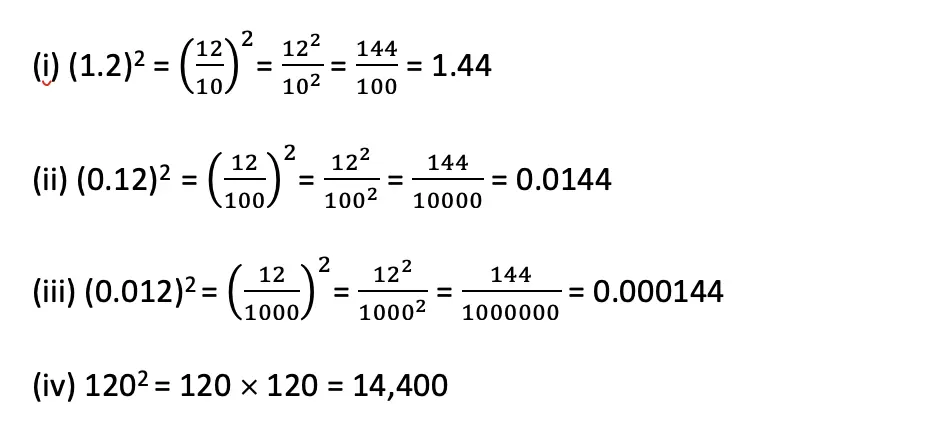
6. If 122 = 144, what is: (i) (1.2)2 (ii) (0.12)2 (iii) (0.012)2 (iv) 1202?
7. Circle the numbers that are the same:
24 × 36, 64 × 32, 610, 182 × 62,
624
64 × 32 = 24 × 34 × 32 = 24 × 36.
182 × 62 = (2 × 9)2 × (2 × 3)2 = 24 × 36.
Therefore, 24 × 36, 64 × 32, and 182 × 62 are the same.
8. Identify the greater number in each of the following:
(i) 43 or 34 (ii) 28 or 82 (iii) 1002 or
2100
(i) 43 = 64, 34 = 81 → 34 is greater.
(ii) 28 = 256, 82 = 64 → 28 is greater.
(iii) 1002 = 10,000, while 2100 = (210)10 = 102410 → 2100 is greater.
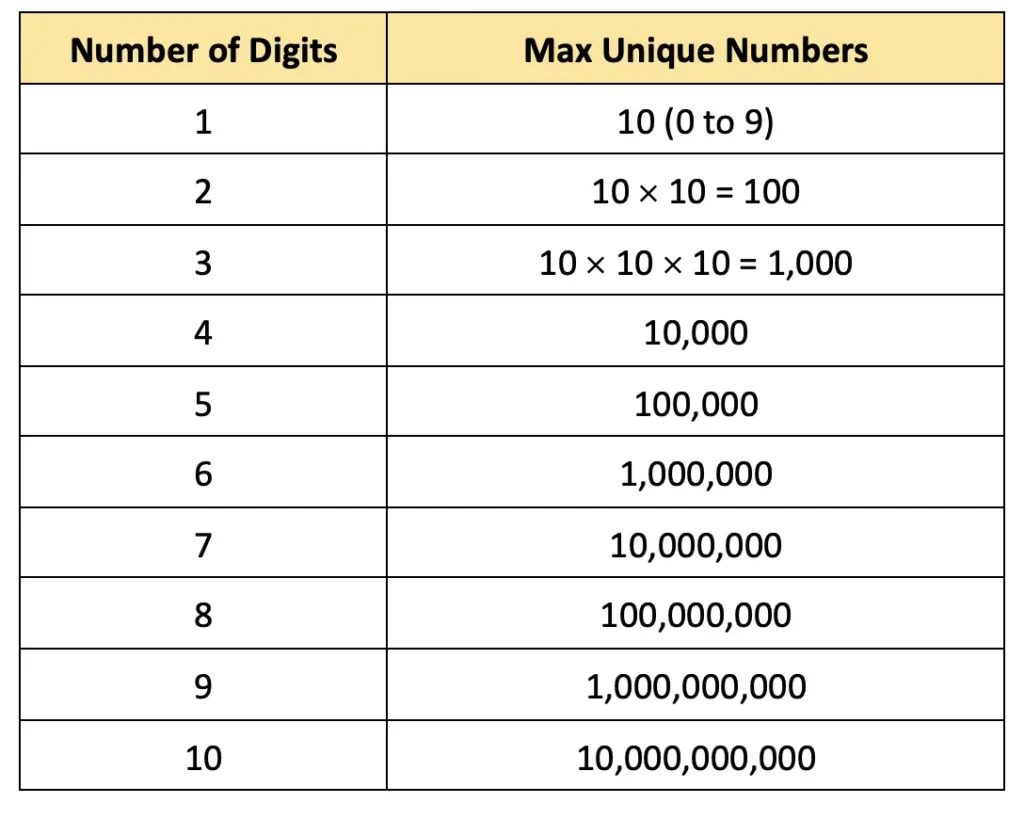
9. A dairy plans to produce 8.5 billion packets of milk in a year. If they use digits 0–9 for a unique ID on each packet, how many digits should the code consist of?
8.5 billion = 8,500,000,000.
10. 64 is a square number (82) and a cube number (43). Are there other numbers that are both squares and cubes? Is there a way to describe such numbers in general?
Yes. General Rule: The sixth power of any number (n6) is both a square and a cube.
Examples: 16 = 1, 26 = 64, 36 = 729, 46 = 4096, 56 = 15,625.
11. A digital locker has an alphanumeric passcode of length 5 (digits 0-9 and letters A-Z). How many such codes are possible?
Choices per slot = 26 + 10 = 36.
Total possible codes = 365.
12. The worldwide population of sheep is about 109, and that of goats is also about the same. What is the total population of sheep and goats?
Total = 109 + 109 = 2 × 10⁹.
Correct options: (v) 2 × 10⁹ and (vi) 109 + 109.
13. Calculate and write the answer in scientific notation:
(i) If each person had 30 pieces of clothing (world pop ≈ 8 × 10⁹).
(ii) 100 million bee colonies with 50,000 bees each.
(iii) Bacterial cells (38 trillion per human) in the entire world population.
(iv) Total seconds spent eating in an 80-year lifespan (1.5 hours/day).
(i) (8 × 109) × 30 = 2.4 × 10¹¹ pieces.
(ii) (1 × 108) × (5 × 104) = 5 × 10¹² honeybees.
(iii) (3.8 × 1013) × (8 × 109) = 3.04 × 10²³ bacteria.
(iv) 1.5 × 3600 = 5400 s/day; 80 × 365 = 29,200 days → 5400 × 29,200 = 1.5768 × 10⁸ seconds.
14. What was the date 1 billion seconds ago?
1,000,000,000 ÷ (60 × 60 × 24 × 365) ≈ 31.71 years (31 years and 259 days).
From 28 July 2025:
Subtract 31 years → 28 July 1994.
Subtract 259 days → 11 November 1993.

No comments:
Post a Comment